


Innovation: efficient window heat pump
The most efficient window heat pump prototype is installed for testing by NYCHA.
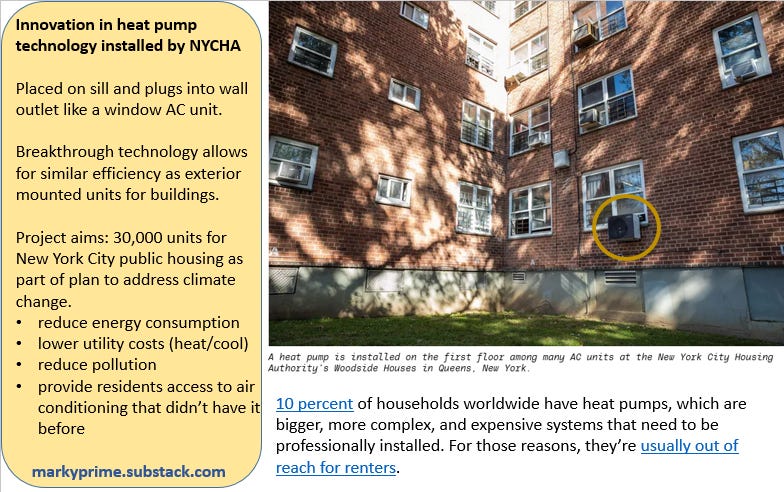
As reported in The Verge, this prototype is a breakthrough in window mounted heat pump technology.
Summary -
domestic manufacturing of heat pumps is expected to rise due to the Defense Production Act
window mounted heat pumps open energy efficiency for heating and cooling to renters/rental units/public housing
Heat and hot water in buildings create about 40 percent of New York City’s planet-heating greenhouse gas emissions. In 2021, NYCHA and its partners announced a $263 million investment in electric heat pumps. They called it the “Clean Heat for All Challenge,” a competition for companies to design a heat pump that would work in cold climates and be installed in existing windows.
Two companies won the Clean Heat for All Challenge last year: appliance manufacturer Midea and San Francisco startup Gradient. New York Power Authority provided the initial $70 million in financing for the first 30,000 heat pumps. The New York State Energy Research and Development Authority contributed $13 million for the demonstration phase of the project.
NYCHA won’t install all 30,000 units at once — which covers around 10 percent of public housing in the city. In the summer, NYCHA placed 36 units from Midea with tenants in a housing development in Queens. Another 36 are expected to be installed in residents’ homes by the end of the year. NYCHA will monitor those units throughout the winter, measuring how much energy they use and checking indoor temperatures.
Over the next five to 10 years, NYCHA thinks it might need 156,000 window heat pumps to comply with local climate law.
the prototype heat pump doesn’t block the window like a typical AC unit would since it hangs down from the sill.
NYCHA is moving toward a goal of ending gas boiler use for heating by providing window heat pumps to public housing tenants (thereby providing heat and cooling for the same appliance unit)
NYCHA proposes replacing boilers with individual heat pumps could avoid a dangerous loss of heating across an entire building. If a boiler goes out, a whole building might lose heat. But if one heat pump goes out in someone’s living room, for instance, that shouldn’t affect another heat pump in the bedroom.
NYCHA is the biggest landlord in New York City, after all, and is already thinking about the possibility of putting this new technology in many of its more than 177,000 apartments. New York Power Authority says it’s also considering installing heat pumps across other governmental properties it serves. Those kinds of contracts have the power to make heat pumps the new norm by giving the industry incentive to scale and lowering manufacturing costs.
The biggest impact heat pumps can make won’t come from enticing individual consumers — replacing appliances one apartment at a time. It comes from making gas boilers obsolete for entire buildings. The way to make more energy-efficient appliances accessible to renters might also be to make sure they’re already in the building. In 2019, New York state passed a law to reduce the greenhouse gas emissions causing climate change by 85 percent by 2050.
10 percent of households worldwide have heat pumps, which are large, more complex, and expensive systems that need to be professionally installed. For those reasons, they’re usually out of reach for renters.
NYCHA pays for residents’ heating and electricity in a majority of its buildings, which the agency says wouldn’t change. NYCHA hasn’t made any decisions yet on air conditioning costs.
Author’s note: I’ve already considered window heat pump units, however those units did not produce heat below 40 F, with a cost of $1800. The low profile heat pump window sill prototype may have an intitial retail cost of $5000, which needs to be manufactured at scale to retail for $2500 or less for me to consider it.
The NYCHA agency has been under federal monitor since 2019 after an investigation into years of mismanagement and unsafe housing conditions, including heat outages that affected hundreds of thousands of residents. A 2020 audit from the New York City comptroller found that NYCHA “failed to maintain a complete inventory of its boilers, adequate records that boiler inspections were conducted, and to ensure that deficiencies cited in inspections were corrected.” Under the terms of the monitorship, NYCHA is supposed to replace aging boilers.
I think the missed opportunity with the NYCHA was to first invest in radiant barrier insulation for the roof of several buildings, and then monitor temperatures across apartment units. That would mitigate hot and cold temperatures for all residents, and perhaps reduce utility costs and help prevent freezing temperatures in the case of a boiler failure. With sufficient radiant barrier insulation NYCHA could stabilize apartment temperature in the winter to at least 55 F, so residents would not face freezing conditions. Sure, it is another project to deal with heat loss through windows and walls, but start with the roof and measure results.
The radiant barrier insulation approach, to me, is the one I would like to test on an attached property with the heat off during winter to determine what the temperature would stabilize at. Then along with the use of individual infrared radiant heater units, and portable heat pumps to compare electric heat to gas boiler usage. Update: after some preliminary testing with portable heat pump technology, the solution if the gas boiler malfunctions, is to rely on portable heat pump units, which cover approximately 500 SF. -Marky
Author’s note: I use a Portable Heat Pump, which exhausts through a window vent panel and does not require permanent installation. Low cost unit, energy efficient, with multiple functions: heat, cool, fan, dehumidifier. Since my primary consideration for testing the unit is heating, rather than cooling, I use a single-hose model, which means the heat pump is using indoor air, which is already relatively warm, 55 - 65 F. So the unit is energy efficienct for winter heating, as it only has to exchange the air over the coils to raise the temperature ten degrees or so, depending on how cool the room temperature is at any given time compared to the thermostat sensor on the portable heat pump. -Marky